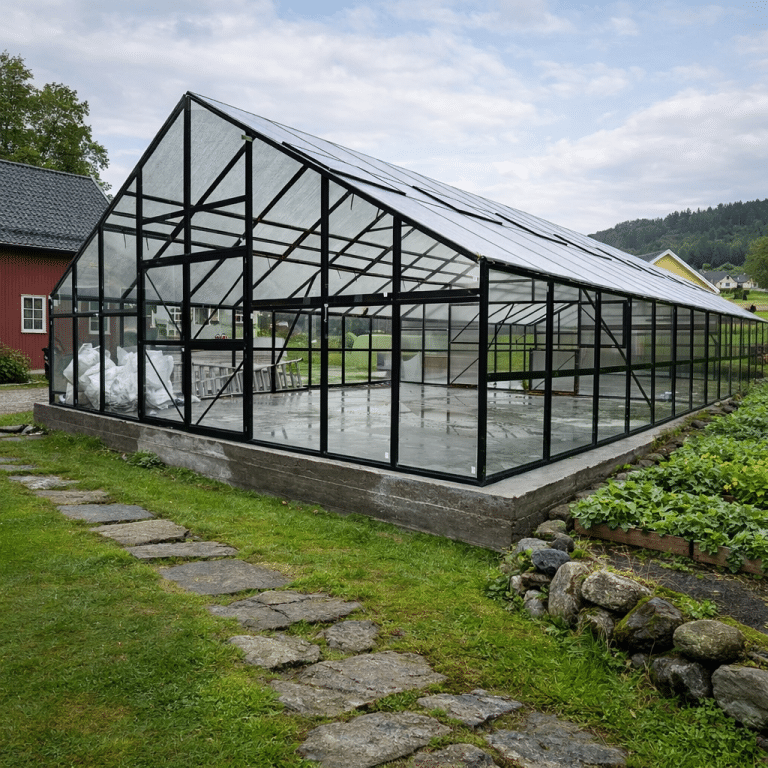
Greenhouses are a fantastic solution for anyone looking to extend their growing season, protect their plants, and create a controlled climate for growing. But there are many different types of greenhouses, and one of the most common choices is the uninsulated greenhouse. In this post, we’ll go over what you can expect from an uninsulated greenhouse, how it works, and what you can do to ensure the best possible results.
Some important factors that affect how tight a greenhouse is:
- Proper assembly – all profiles and panels must be assembled exactly according to the instructions.
- Using sealants – silicone or other suitable sealant can help prevent water ingress.
- The substrate – an uneven foundation can create small gaps that lead to leaks.
- Retrofitting sealing strips – extra rubber strips or foam sealing can make the greenhouse more resistant to rain.
We have many customers who get their greenhouse completely tight, but this requires precise assembly and jointing to achieve the best possible result.
What is a greenhouse and why does it have a roof?
A greenhouse is not just a construction made of glass or polycarbonate – it is a protective growing structure that provides a better environment for plants. The main purpose of a greenhouse is to:
- Protect plants from extreme weather conditions such as heavy rain, wind, hail and frost.
- Create a warmer climate by collecting and storing solar heat during the day.
- Reduce temperature differences between day and night, which promotes healthy growth.
- Control humidity and airflow for better growing conditions.
The roof of a greenhouse is particularly important for directing water away from the structure and providing a sheltered environment for the plants. However, it is important to understand that a greenhouse is not a waterproof building, but a structure designed for optimal plant growth.
Uninsulated greenhouses – what you should know
Many people choose uninsulated greenhouses because they are affordable and easy to install. These greenhouses are usually made of single-layer polycarbonate or tempered glass and have a sturdy frame made of aluminum or galvanized steel.
Advantages of uninsulated greenhouses:
- More affordable than insulated greenhouses – a good option for hobby growers.
- Easy and quick assembly – easier to set up than heavier, insulated models.
- Provides good protection from the elements – prevents frost, rain and pests from damaging the plants.
- Good ventilation – simple air vents ensure natural air flow.
Challenges with uninsulated greenhouses:
- No insulation – temperature differences can be large between day and night.
- No guarantee of being 100% tight – small openings in joints and transitions can let water in during heavy rain.
- Condensation can occur – especially on cold nights when warm air meets colder surfaces.
Leakage in greenhouses – what should you expect?
All our greenhouses are delivered flat-packed and assembled by the customer themselves. This means that the quality of assembly plays a big role in how tight the greenhouse will be.
Fasadenor does not offer a leak guarantee, which is standard practice among Norwegian retailers. This does not mean that your greenhouse will necessarily leak, but that you must take extra measures to seal joints and transitions.
Condensation in greenhouses – why does it occur and what can you do about it?
Condensation is a natural phenomenon in all greenhouses, especially uninsulated models. When warm air inside the greenhouse meets colder surfaces, water droplets form on the inside.
To reduce condensation, we recommend:
- Good ventilation – make sure the greenhouse has air vents or automatic hatch openers.
- Avoid overwatering – too much moisture in the soil can increase humidity.
- Use a small fan – this helps distribute heat and air more evenly in the greenhouse.
- Choose a good foundation – gravel or concrete with good drainage can minimize humidity.
How to make an uninsulated greenhouse as airtight as possible?
If you want a greenhouse as airtight as possible, you can follow these tips:
- Gluing all joints and transitions – use silicone or sealant around glass or polycarbonate sheets.
- Extra sealing strips – retrofitting rubber strips or foam sealing can contribute to better tightness.
- Ensure a smooth and stable foundation – a greenhouse should stand on a solid and level surface.
- Tighten screws regularly – greenhouses can move a little over time, so it is a good idea to check the fasteners.
- Proper installation of the roof – the roof should lead water away, so proper installation is important to avoid leaks.
If you do not have experience with installation, it may be a good idea to use a professional installer or a glazier to ensure the best possible result. Greenhouse assembly requires precision, and it can be an advantage to get help from someone with experience.
Conclusion
- Greenhouses are designed to provide a favorable growing environment, but are not 100% waterproof buildings.
- Uninsulated greenhouses are a cost-effective choice, but may require additional measures to become completely sealed.
- Fasadenor does not offer a leak guarantee, but with proper installation and use of sealant, very good results can be achieved.
- Condensation is a natural part of the greenhouse environment, but can be controlled with ventilation and good aeration.
- For the best possible results, you should ensure good installation, sealing and a stable foundation.
We hope this post has given you useful information about uninsulated greenhouses and what you can expect. If you have any questions or would like more information about our models, you are always welcome to contact us!
Fasadenor – your expert in greenhouses and garden products