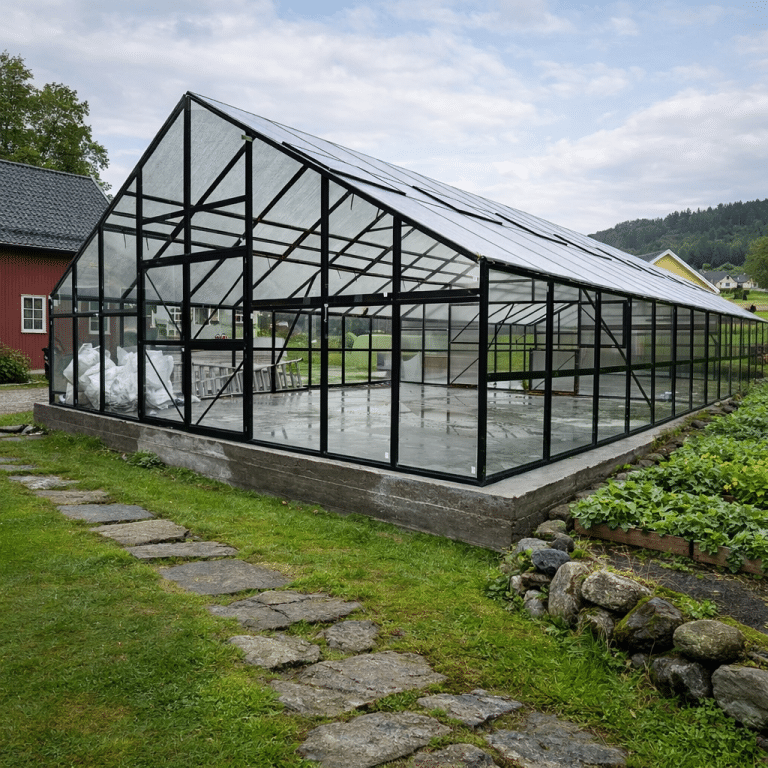
When considering purchasing a greenhouse, it is important to understand what type of construction you are investing in and how it differs from an insulated conservatory. Many people expect a greenhouse to be completely airtight and have stable temperature conditions throughout the year, but this is not the case. A greenhouse and an insulated conservatory have completely different uses, materials and characteristics.
What is a greenhouse?
A greenhouse is a structure designed to provide plants with a protected growing environment. It is primarily used to extend the growing season and protect plants from weather conditions such as rain, wind and cold. Greenhouses are built to let in sunlight and retain heat, but they do not have insulation in the same way as a conservatory.
Most greenhouses are made of single-layer glass or polycarbonate mounted in an aluminum frame. This provides good lighting conditions for the plants, but limited protection against temperature changes. In the summer, it can get very hot inside a greenhouse, while the temperature at night and in the winter months can be correspondingly low.
Greenhouses have natural ventilation openings through doors, air vents and joints between the panels. This is necessary to regulate the temperature and prevent overheating. Because a greenhouse has many joints and moving parts, small openings can occur where water can penetrate during heavy rain. To achieve the best possible tightness, it is often necessary to use sealant or additional sealing strips.

What is an insulated conservatory?
An insulated conservatory is a more solid and protective structure designed to maintain a stable indoor climate. Unlike greenhouses, a conservatory is built with insulated materials such as double or triple glazing and solid frames. This provides better protection against cold, wind and moisture.
Conservatories often have better sealing solutions and more robust structures, making them suitable for use all year round. They retain heat better in winter and prevent overheating in summer.
While greenhouses are designed to provide optimal growing conditions for plants, a conservatory is more adapted to create a comfortable environment regardless of the season.
The main differences between a greenhouse and an insulated conservatory
The main difference between a greenhouse and an insulated conservatory lies in the choice of materials and insulation capacity. Greenhouses have a simpler construction with thinner panels and ventilation openings that release heat and moisture. This means that it is not guaranteed to be waterproof without additional measures and that condensation may occur on the inside.
In an insulated conservatory, the materials are designed to provide better temperature control and less air leakage. Insulated glass walls and weatherstripping prevent drafts and ensure better regulation of heat and cold.
A greenhouse is an excellent solution for growing and protecting plants, but it is not designed to maintain stable temperatures all year round. A conservatory, on the other hand, has better temperature control and is suitable for use all year round.
What should you choose?
If your goal is to grow plants in a protected environment, a greenhouse is a good choice. It provides shelter, retains heat from the sun and prevents damage from wind and weather. However, if you want a more protected and stable construction, an insulated winter garden may be a better option.
To make a greenhouse as airtight as possible, it is recommended to use sealant around joints, ensure proper assembly and choose a model with solid profiles and additional sealing solutions.
It is important to have realistic expectations of what a greenhouse can offer, so that you get a solution that suits your needs. If you have any questions or would like more information about our greenhouse models, you are welcome to contact us at Fasadenor.