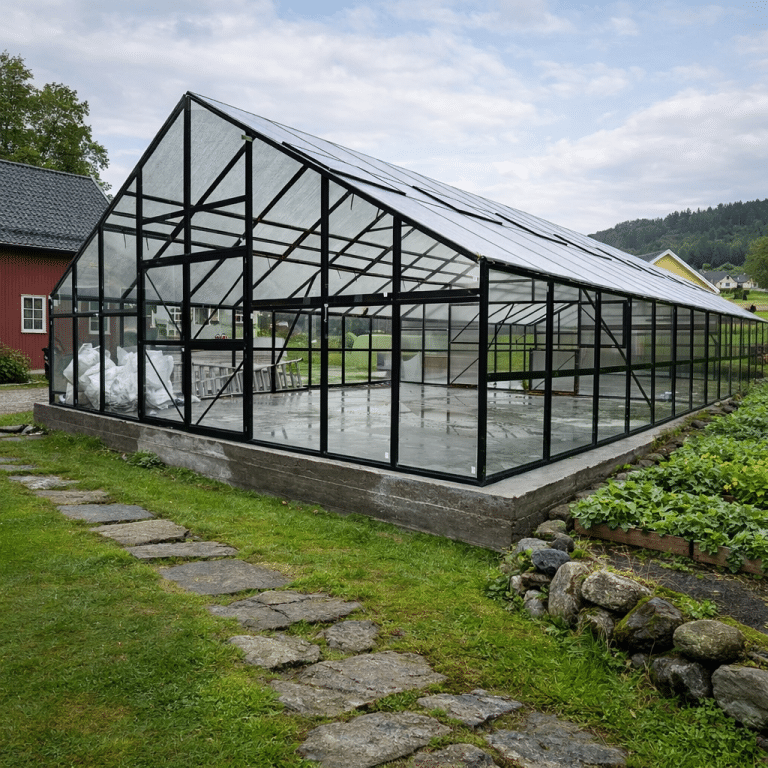
That’s why no retailers have a water leakage guarantee on greenhouses in Norway, the Nordic countries or Europe
When investing in a greenhouse, it is natural to want a product that protects the plants from the elements. Many expect greenhouses to be completely airtight, but the truth is that no retailers in Norway, the Nordic countries or Europe offer a water leakage guarantee on greenhouses. The reason for this is simple – manufacturers and factories do not provide this guarantee to their customers or retailers.
In this post, we explain why greenhouses are not guaranteed to be waterproof, and how this differs from insulated conservatories, which have a completely different construction and price.
Why don’t greenhouses have a water leakage guarantee?
There are several reasons why no manufacturers or retailers provide a guarantee against water leakage on greenhouses.
1. Greenhouses are not designed to be waterproof
Greenhouses are primarily designed to create a good growing environment for plants. They are not designed to be hermetically sealed structures, but rather to provide a controlled climate that lets in sunlight and retains heat.
Greenhouses have joints, air vents and moving parts, which allow small openings to occur. These openings are necessary to ensure ventilation and prevent overheating on hot days.
2. Production is standardized
Greenhouses are manufactured in factories where they are designed to be easy to assemble and adapted to different climate conditions. Most models are delivered flat-packed and assembled by customers themselves or by installers with varying levels of experience. This means that the final result may vary from customer to customer.
Because factories have no control over the assembly process, they also do not offer any guarantee that the final result will be completely watertight. This is one of the main reasons why a water leakage guarantee is not part of the standard terms and conditions for greenhouses.
3. Weather conditions vary
Greenhouses are exposed to a wide variety of weather, including heavy rain, snow and wind. Even a solidly assembled greenhouse can experience small water intrusions during extreme weather conditions.
To minimize leaks, it is recommended to:
- Use silicone sealant in joints to seal openings.
- Install extra sealing strips for better insulation.
- Ensure a stable foundation, so that the greenhouse does not move over time.
- Regularly retighten screws and profiles, as temperature changes can lead to small shifts in the materials.
The price difference between greenhouses and insulated conservatories
Many people wonder why an insulated conservatory costs significantly more than a greenhouse. The main explanation lies in the choice of materials, insulation and waterproofing.
1.Material differences
Greenhouses are usually made of single-layer glass or polycarbonate mounted in a lightweight aluminum frame. This provides a functional greenhouse, but offers little protection against cold and weather.
Insulated conservatories, on the other hand, are built with double or triple glazing, solid frames with broken thermal bridges and additional sealing systems. This makes them far more energy efficient and resistant to moisture and leaks.
2.Insulation and waterproofing
Greenhouses have minimal insulation, which means that they will have large temperature variations between day and night. A conservatory is fully insulated and designed to retain heat and prevent drafts and moisture.
Greenhouses often require additional measures such as joints and sealing strips to prevent water ingress, while a conservatory is designed to be completely sealed from the factory. This is one of the biggest reasons for the price difference.
3. Building permit and installation
Greenhouses rarely require building permits, and most models can be installed by the customer themselves. Conservatories, on the other hand, often require building permits and professional installation, which increases the cost.
A conservatory also has a much more extensive construction, including insulated floors, walls and roofs, making it a permanent part of the property. Greenhouses, on the other hand, are simpler structures designed for seasonal use.
What should you choose?
If you want an affordable and functional greenhouse for plants, a greenhouse is the right choice. With proper installation and additional sealing, you can reduce leaks and create a stable environment for growing.
However, if you want a fully insulated, waterproof and energy-efficient solution, you should consider a conservatory. This is an investment that provides comfort all year round, but it also involves a significantly higher cost.
Conclusion
- No greenhouse retailers in Norway, the Nordic region or Europe offer a water leakage guarantee, because manufacturers do not provide this guarantee to retailers or customers.
- Greenhouses are not designed to be completely airtight, but to provide a controlled growing environment for plants.
- With proper assembly and sealing, you can minimize leaks, but be aware that ventilation openings and moving parts can always cause small gaps.
- Conservatories are significantly more expensive than greenhouses, because they are designed to be insulated and waterproof.
- The choice between a greenhouse and a conservatory depends on what you need – a protected growing room for plants or a year-round solution with full insulation.
Do you have questions about greenhouses or conservatories? Contact us at Fasadenor, and we will help you find the solution that best suits your needs.